← Back to Resources
Try these 10 Free AI courses in 2026
2026 roadmap to master AI for non-technical people
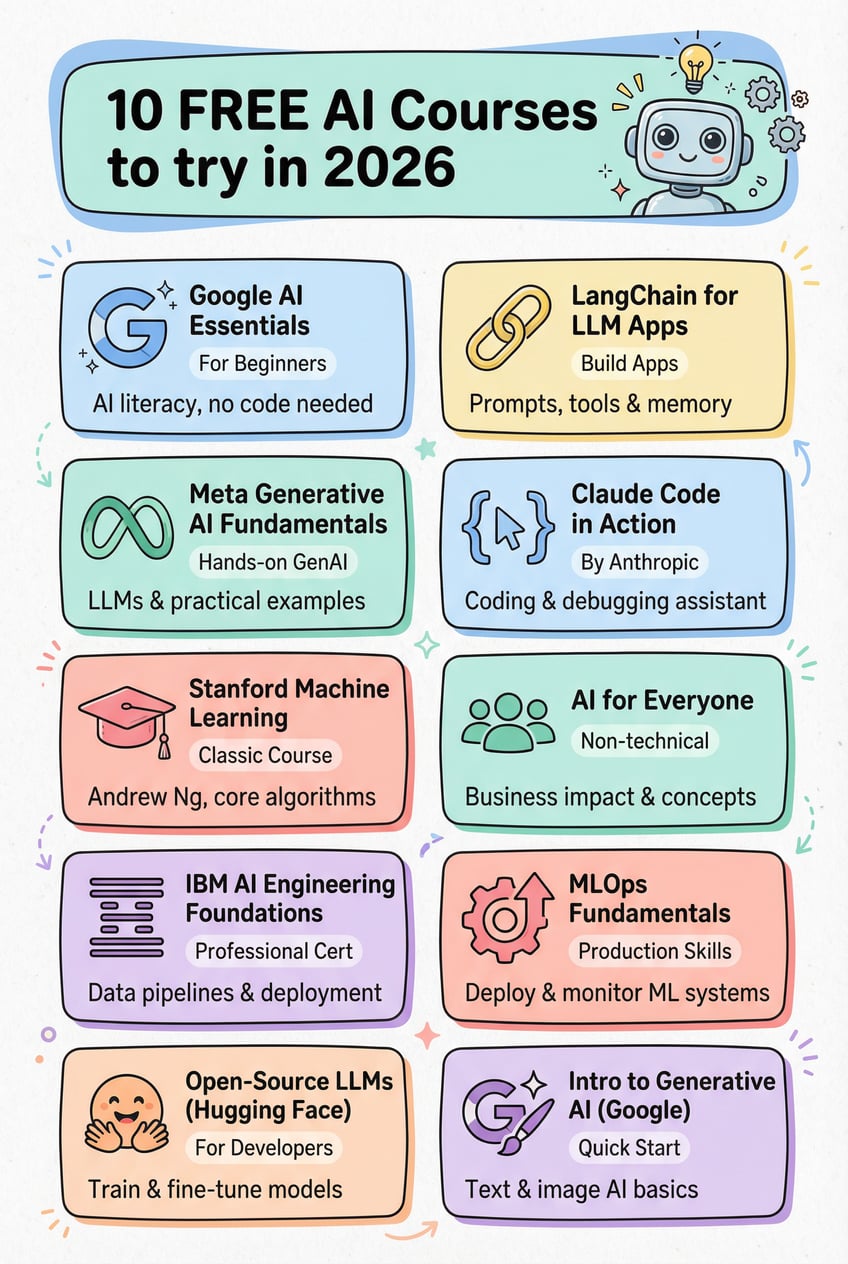
10 FREE AI Courses to try in 2026
1. Google AI Essentials
Offered by Google, this course explains what AI is and how to use it responsibly in real work scenarios. It is designed for beginners who want practical AI literacy without touching heavy math or code.
2. Meta Generative AI Fundamentals
Created by Meta, this course introduces large language models and generative AI concepts through hands-on examples. It focuses on how modern GenAI systems work and where they are applied in products.
3. Stanford Machine Learning
Taught by Andrew Ng and published by Stanford University, this is the classic foundation course for machine learning. It covers core algorithms like regression, neural networks, and optimization in a structured academic way.
4. IBM AI Engineering Foundations
This professional certificate from IBM focuses on building applied AI engineering skills. It introduces data pipelines, model deployment concepts, and practical workflows used in industry.
5. Open-Source LLMs with Hugging Face
Hosted by Hugging Face, this course teaches how open-source large language models are trained, fine-tuned, and evaluated. It is hands-on and ideal for developers who want to work directly with real models.
6. LangChain for LLM Application Development
Created by DeepLearning.AI, this course shows how to build LLM-powered applications using LangChain. It focuses on chaining prompts, tools, memory, and external data into working systems.
7. Claude Code in Action
Provided by Anthropic, this course demonstrates how Claude can assist with coding tasks and reasoning workflows. It emphasizes real developer use cases like refactoring, debugging, and code understanding.
8. AI for Everyone
Another course by Andrew Ng, this one targets non-technical learners. It explains AI concepts, limitations, and business impact without requiring programming knowledge.
9. MLOps Fundamentals
Offered by Made With ML, this course focuses on deploying, monitoring, and maintaining machine learning systems. It covers versioning, testing, data drift, and production reliability.
10. Introduction to Generative AI with Google
Developed by Google, this course explains how generative AI models like text and image systems are built and used. It serves as a short, structured entry point into Google’s GenAI ecosystem.